
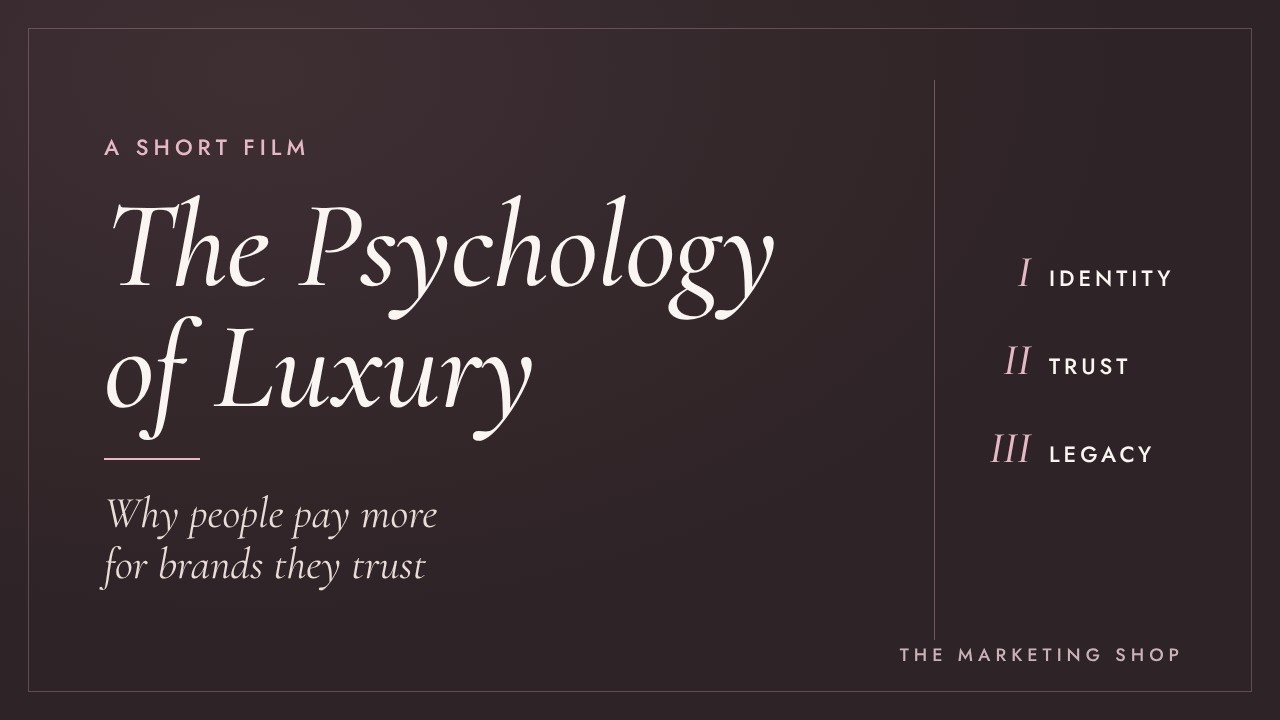
Two white shirts hang side by side, cut from the same cotton. One costs forty dollars and the other costs four hundred, and a surprising number of people reach for the more expensive one with very little hesitation. The second shirt is probably not ten times better made, and most of the people who buy it know that perfectly well. What they are paying for is harder to name than thread count, and the great luxury houses have spent generations learning to name it, shape it, and protect it. That unnamed quality is the subject of our short film, and of this essay.
We made The Psychology of Luxury because the question it asks reaches well beyond handbags and hotel suites. The same instinct that sends a buyer toward the four-hundred-dollar shirt also sends a general counsel toward one law firm over another, a family toward a particular architect, and a hiring manager toward the recruiter whose name keeps coming up in conversation. If you have three minutes, watch the film first. What follows is the longer conversation it was designed to begin.
Why the price is rarely about the object
Economists have long distinguished between what a thing costs to make and what it is worth to the person buying it, and luxury lives almost entirely in the space between the two. A watch tells time, a car carries its passengers from one place to another, and a hotel room offers a comfortable bed behind a locked door. Those functions are available at nearly every price point, which means the premium attached to the finest versions of them must be paying for something other than function. It is paying for meaning, for confidence, and for a feeling that tends to outlast the purchase itself.
When you study how people make expensive decisions, three quiet questions appear again and again beneath the surface. The first is What does this say about me?, which is a question of identity. The second is Can I rely on it?, which is a question of trust. The third, and the subtlest, is What story am I joining?, which is a question of legacy. Buyers rarely ask these questions aloud, and many would not recognize them as the reasons behind their choices, yet the brands that command a premium have answered all three long before the customer walks through the door.
What does this say about me? The psychology of identity
Gabrielle Chanel understood that clothing could carry a point of view. At a time when women’s fashion was defined by corsetry and ornament, she made simplicity her signature, and the little black dress she popularized in the 1920s became a statement a woman could wear rather than one she had to explain. To choose Chanel was to align oneself with a particular idea of elegance, one that was restrained, modern, and quietly certain of itself. The garments were beautiful, but the association was what the customer carried home.
What is striking is how little of this depends on volume. Research on luxury consumption suggests that the most established buyers often prefer subtle signals to obvious logos. A widely cited 2010 study in the Journal of Marketing by Young Jee Han, Joseph Nunes and Xavier Drèze found that affluent consumers with little need to prove their status gravitated toward quieter branding, recognizable mainly to others who knew how to read it, while those eager to be seen paid for louder marks. Jonah Berger and Morgan Ward reached a related conclusion the same year in the Journal of Consumer Research, showing that people with deep knowledge of a category often favored inconspicuous signals precisely because they distinguished insiders from everyone else.
The lesson for any brand is that identity works best when it is offered rather than announced. A great brand hands its customer a sentence they never have to say out loud, something close to this is who I am, and this is what I value. Professional relationships work in much the same way. A client who retains a respected firm is also making a quiet statement about their own judgment, and they would very much like that statement to be easy to defend to a board, a business partner, or a spouse.
Can I rely on it? The psychology of trust
The second question concerns time, and for people whose hours are expensive, time is the scarcest resource in any decision. Comparing options carries a real cost. Every evening spent reading reviews, requesting proposals, checking references, and second-guessing a choice is time taken from the work and the people that matter most, and the more consequential the decision, the heavier that cost becomes. A trusted name reduces it dramatically, because it allows the buyer to borrow the judgment of everyone who chose well before them.
Rolex built its reputation on precisely this kind of reliability. Its waterproof Oyster case, introduced in 1926, was famously put to the test the following year when the swimmer Mercedes Gleitze wore one during an attempt to cross the English Channel, and the company has spent the century since making precision and durability central to its identity. The people who buy a Rolex are rarely looking for a more accurate way to tell time than the phone in their pocket provides. They are buying the assurance that the object on their wrist will perform, will endure, and will hold its standing for decades.
Rolls-Royce offers an even more vivid illustration of how far trust can travel. The company became such a byword for quality that its name left the automotive world altogether, and people now speak of “the Rolls-Royce” of nearly anything, from espresso machines to garden tools, to describe the finest example of its kind. That is a reputation that has been turned into language, and it reveals something important about what the buyer is actually purchasing at the top of any market. Much of what they pay for is the end of doubt.
What story am I joining? The psychology of legacy
The third question is harder to see because it concerns what happens after the transaction. A hotel stay cannot be handed down the way a watch can, and yet The Ritz-Carlton has built one of the most admired names in hospitality around the idea that each guest steps into a standard of service that existed before they arrived and will continue long after they leave. Its well-known motto, “We are Ladies and Gentlemen serving Ladies and Gentlemen,” describes a culture far more than a service level. The guest is welcomed into something with a history, and the evening becomes part of their own story as well: the anniversary dinner, the quiet weekend away, the night spent somewhere that knew exactly how to treat them.
Fine watchmaking understands this instinct beautifully. Patek Philippe’s long-running advertising suggests that one never truly owns one of its watches, only looks after it for the next generation, and in doing so it turns a purchase into an act of stewardship. The buyer becomes a custodian within a lineage that will outlast them, which is a far more compelling role than that of an ordinary customer. As we explored in The Architecture of Influence, the brands that endure are the ones built patiently enough to have a past worth inheriting.
Legacy matters because people want their choices to connect them to something durable. They want to belong to a story with continuity, standards, and a future. The brands that offer this rarely sell it directly; they demonstrate it through consistency over many years, through the stories they keep telling about themselves, and through the visible care with which they protect their own history.
A premium is what people pay to stop wondering
Put the three questions together and the price begins to make sense. When a brand has already answered who its customer becomes, whether it can be relied upon, and what story the customer is joining, the buyer no longer needs to deliberate. The uncertainty that normally accompanies a significant purchase has been resolved in advance, and that resolution has value of its own. A premium is what people pay to stop wondering.
This idea explains a great deal about premium pricing that conventional thinking tends to miss. We often assume people pay more because they believe they are getting more, and sometimes that is true. More often, people pay more because they are risking less. The higher price buys relief from the nagging questions that follow an unfamiliar choice: whether they chose correctly, whether the result will embarrass them, and whether they ought to have kept looking. For a buyer who values their time and their reputation, removing those questions is worth a great deal.
It also explains why trust and price tend to reinforce each other. A brand that has earned confidence can charge more, and the price, in turn, signals that the confidence is warranted. That relationship only holds when the trust is both real and visible. A high price without visible reassurance invites suspicion rather than relief, which is why the most enduring premium brands invest so heavily in making their identity, reliability, and history easy to see.
The same three questions follow every professional service
None of this belongs only to luxury. The same three questions follow a law firm, an architecture practice, a recruiting company, and a family business that has been trusted in its community for forty years. In many ways they press even harder on professional services, because the buyer cannot inspect the work before committing to it. Economists describe legal counsel, design expertise, and similar services as credence goods, offerings whose quality is difficult to judge even after the fact, let alone beforehand. When quality cannot be examined directly, people rely on signals, associations, and reputation to decide whom to believe.
The law firm
Consider a client choosing representation for a matter that keeps them awake at night. They are asking what their choice of counsel says about how seriously they are taking the problem, whether this firm will handle it with competence and discretion, and whether they are joining a practice with a record of seeing clients through situations like theirs. A firm with decades of distinguished work may answer every one of those questions brilliantly in person. The difficulty is that the client usually forms an impression well before the first consultation, assembled from a website, a handful of attorney profiles, and whatever else a search returns. That first impression is already part of the decision, which is why we describe a firm’s website as part of the sales conversation even when no one from the firm is in the room.
The architecture practice
An architecture practice faces a similar challenge with a different emotional texture. A family commissioning a home, or a board approving a new building, is making a decision they will live inside for decades. They want to know that the architect’s sensibility reflects their own, that the practice can manage budgets, contractors, and approvals without drama, and that the finished work will become a place they are proud to be associated with. A thoughtfully presented portfolio, with the story and reasoning behind each project, answers those questions far more persuasively than any claim of excellence ever could.
The recruiting firm
Recruiting firms live with the trust question every day, and on two sides at once. Employers need to believe a recruiter understands their industry well enough to represent them to candidates, and candidates need to believe the recruiter will advocate for their careers rather than simply fill an opening. The strongest firms are often known by name within their niche, yet a hiring manager encountering one for the first time may find little more than a list of open roles and a generic description of services. The expertise exists; it simply has not been placed where a new prospect can weigh it, which is the particular problem a recruiting firm website should be built to solve.
The family business
The multigenerational family company may hold the most powerful legacy story of all, and it is frequently the least documented. Forty years of dependable service, relationships carried from one generation to the next, and a standard of care that customers have quietly come to expect are exactly the qualities luxury houses spend fortunes to communicate. Too often they live only in the memories of longtime customers and in the instincts of the family who runs the business. A new customer, particularly one who researches everything before picking up the phone, has no way to see them.
The reputation is real, but the record is often thin
Luxury houses make their answers visible. Their craftsmanship is documented, their histories are told and retold, and every point of contact, from a boutique window to the tissue paper inside a box, reinforces the same identity. Many established service businesses have earned answers just as strong through years of excellent work and loyal clients. Far fewer have placed those answers anywhere a stranger can find them.
This is the gap we encounter most often in our work with established businesses. The reputation is real, the record of it is thin, and people can only weigh what they can see. A prospective client who discovers the business for the first time is asking the same three questions a luxury buyer asks, and when the answers are not visible, that client is left to wonder. Wondering is costly for the business, because it sends people back to comparing, and comparison has a way of reducing even the most distinguished firm to a line item and a price.
The remedy rarely requires reinvention. It calls instead for the patient work of making an existing reputation visible and easy to evaluate. A well-built website is the foundation, because it is where most people go to confirm what they have already heard, a theme we develop more fully in The Authority Website and in When Your Reputation Has Outgrown Your Website. Case studies reveal the thinking behind the results and answer the trust question with evidence. Editorial content demonstrates expertise the way a fine atelier demonstrates craftsmanship, by allowing people to experience the quality of the thinking for themselves. Considered professional profiles give the people behind the work a credible public presence, and publicity places the business in settings that lend it borrowed authority, much as a respected review does for a celebrated restaurant.
Consistency is the quietest signal of all
One lesson from the luxury world applies with particular force: consistency signals reliability before a single word is read. A Chanel boutique in Paris feels unmistakably related to one on Madison Avenue, and a Ritz-Carlton in one city carries the same bearing as another an ocean away. That coherence tells the customer the organization is deliberate, careful, and in command of its own standards, which is exactly what they hope will be true of the experience itself.
For a professional firm, consistency means that the website, the proposals, the partner profiles, the social presence, and the way people describe the work all express the same identity. The photography feels considered, the language sounds like the people who actually do the work, and the evidence of expertise accumulates over time instead of disappearing into old newsletters and forgotten folders. When a prospective client moves from a referral to a search result to a website to a first conversation and meets the same confident, coherent business at every step, the trust question begins to answer itself. This is the thinking behind our Authority Architecture, which treats the website, editorial content, and social presence as parts of a single structure rather than as separate projects.
Consistency also rewards patience. No luxury house earned its standing through a single campaign, and no professional firm should expect one website launch or one press mention to transform how it is perceived. The firms that build lasting authority add to their record steadily, so that each new case study, article, and profile makes the next decision a little easier for the next client. Over years, that steady accumulation becomes what actually compounds.
The gap isn’t reputation. It’s documentation.
The luxury houses teach us that people pay more when they no longer have to wonder, and that the end of wondering comes from identity, reliability, and legacy made visible. Established service businesses already possess the substance those brands work so hard to communicate. The years of good work, the satisfied clients, the relationships carried across decades, and the standards held quietly in place are real assets, and many of them are more meaningful than anything a marketing department could invent.
What these businesses often lack is a record that a stranger can see and evaluate on their own time. That is where the opportunity lies, and it is a far more encouraging place to begin than most owners expect. No one needs to manufacture a reputation they have already earned. The work is to document it with the same care that went into building it, through a website that reflects the quality of the firm, case studies that show the thinking, editorial writing that demonstrates expertise, and a public presence consistent enough to be trusted on sight.
So consider, as candidly as you can, what happens when someone finds your business for the first time. How much are they left to wonder? For most of the established firms we meet, the honest answer points to the same conclusion. The gap isn’t reputation. It’s documentation.
Read the film transcript
0:00 Two white shirts made from the same cotton. One costs $40. The other costs $400, and people choose it anyway. It’s probably not 10 times better made. The difference is something the customer would find hard to name. Luxury brands have learned to name it.
0:20 Under most expensive decisions, we’d say, sit three quiet questions. What does this say about me? Can I rely on it? What story am I joining?
0:32 The first is about identity. Gabrielle Chanel made simplicity her signature, and the little black dress became a point of view you could wear. None of it needs to be loud. Research on luxury buyers suggests the most established often prefer quieter signals, the kind only insiders recognize. The brand hands its customer a sentence they never have to say aloud: This is who I am.
0:59 The second question is about time. For someone whose hours are expensive, comparing options is a cost, and a trusted name reduces it. Rolls-Royce became such a byword for quality that its name left the car business. People call the best of almost anything the Rolls-Royce of its kind. A reputation turned into language. Much of what the buyer pays for is the end of doubt.
1:27 The third question is the subtlest. A hotel stay can’t be handed down like a watch, but at The Ritz-Carlton, a guest steps into a standard of service that was there before they arrived and will be there after they leave. Its motto puts it simply: “We are Ladies and Gentlemen serving Ladies and Gentlemen.” The stay ends, but the memory doesn’t, and it becomes part of the guest’s own story. An anniversary, or an evening somewhere that knew exactly how to treat them.
2:03 Put the three together and the price starts to make sense. A premium is what people pay to stop wondering.
2:11 None of this belongs only to luxury. A law firm, an architect, a recruiter, a family company trusted for 40 years. The same three questions follow each of them. Luxury houses make their answers visible in their craft and in the stories they keep telling. Many established businesses have earned answers just as strong. Far fewer have put them anywhere a stranger can see.
2:40 The reputation is real. The record of it is often thin. And people can only weigh what they can see. So when someone finds your business for the first time, how much are they left to wonder?